Showing posts with label Workboats. Show all posts

Sunday, April 3, 2011

Raz de Sein

Raz de Sein and the three lighthouses

courtesy
Amoureux de la Bretagne


courtesy John Ushant


courtesy Jean Guichard via Pulgatorio de Tevennec


Ar-men Lighthouse

Courtesy Purgatario de Tevennec


Caprice FLOTS
In 2601
AD 184855
troller built in 1966 in Douarnenez
Site Jean Marie Tanguy
Skippper: Paul Milliner - Ile de Sein
main features;length:6.87 m Width: m GRT: 5.41 tx engine: 41 hp MWM
Incorporated by Eric Losq Plogoff, it was then registered in district of Douarnenez. He is now finishing his life quietly in the cemetery of boats Locquéran
in the port of Breast with Vagabond Islands (photo G) and with Hope in God (photo D)
the bar in the Raz

courtesy Audiernnes les Dundees


cyclone: CYCLONE
In 2666
Ad 279097
potters / long liner / shell built in 1970 to Freight
Construction Stipon
Skipper: Follic François (François Cyclone) - Ile de Sein
main features; length: 9 mwidth: 3.58 m GRT: 7.97 tx engine: 90 hp Baudouin
During a campaign Jacques scallops in the harbor of Brest, "Cyclone" hook a former anchor in the middle of the pool shell and sink. It will then be salvaged and sold to La Rochelle.
Follic Francois (Francois said cyclone, named after his old boat) has long been the patron of the "City of Paris" SNSM the canoe from the island of Sein
the bar in the "Trouziard" also said the Torpedo channel (Raz de Sein in the Old)
A Breast is not only a tradition to name the boat to his boss, it's almost a necessity as many surnames are identical (Spinec, Guilcher, Follic, Milliner, Fouquet ...). Jos Fouquet told me that at one point there were 17 Joseph Fouquet on the island ...
After the accident in the harbor of Brest, "Cyclone" will turn to the districts of Saint Brieuc and then Sables d 'Olonne under the name "Candy" and then to La Rochelle in 2005 still under the same namPhoto taken shortly after the accident at the port entrance channel. The boat was towed to the level of ASM to clear the password input port where it presented a danger

courtesy Audiernnes les Dundees


Cyclone fishing in the Raz. Note the birds. This is how the fishermen hand or longlining for sea bass know where to go.

courtesy Audiernnes les Dundees


Tevennec lighthouse is located at the tip of Raz in Brittany. The transition from the tip of the island Raz de Sein, presents enormous difficulties and dangers, in part to the destructive force of the water.
Crossing
these waters at night is suicide
.

Courtesy Purgatario de Tevennec


The French Raz de Sein translates literally in English as 'storm within'. How apt. It's a treacherous, infamous stretch of water at the confluence of at least two opposing currents off the coast of Brittany that can be a nightmare for mariners. It's also been and is a favorite for adventurous and hardy fishermen attracted to the bountiful sea life there. Sea bass is the draw, apparently sustainably harvested, at least recently. The contemporary practice of fishing in this fabled area is written about in Maritme Life # 34, a sadly defunct publication which was a joint effort between WoodenBoat and Chasse Maree.
here's what Wikipedia has to say about the Raz de Sein:

"The Raz de Sein is a stretch of water located between the Isle of Sein and the Pointe du Raz, in Finistère, in the Brittany region of France.

This tidal water is an essential passage for vessels wishing to pass between the Atlantic and the English Channel because further west, at high tide, the Isle of Sein and its embankment stretch for more than thirty miles.

This is a very dangerous zone for navigation, due to the violent sea currents from the tides (up to six knots during the spring tides). The current causes the sea to rise quickly, and it is recommended that heavy vessels should only attempt to cross this strait at still water during calmer conditions.

The Raz de Sein is bounded by the La Vieille and Petite Vieille lighthouses, and by the shoreline of the île de Sein.

Maritime disasters:

On May 26, 2006, Édouard Michelin died while fishing for sea bass on his ship Liberté. The skipper of the boat, Guillaume Normant, also lost his life in the accident. The boat was found two days later with no apparent damage, roughly 15 km from the Île de Sein."

And Yachting Monthly had this as an introduction to the video below:

"Off the NW tip of Brittany lies the Raz de Sein. Few other stretches of water have such a fearsome reputation: the tide can rip through at 6 knots at Springs, and when an Atlantic storm hits, the result is nothing short of awe-inspiring.

Pity the lighthouse keepers of old. The Ar-Men lighthouse, the most westerly of those marking the shoals around the Île de Sein, was nicknamed the 'Hell of Hells' by its former keepers. Closer inshore, the square tower of La Vieille lighthouse was the second last in France to be automated, due to the protests of the live-in keepers. It took until 1995 for the light to be automated and the keepers to depart."


kayak extrem dans le raz de sein by wavestar


Wednesday, March 9, 2011

Whaleboats for the CW Morgan


A quick post to announce a new weblog I am hosting at the behest of John Brady, lead boatbuilder at the Workshop on the Water, the very active boatshop at the Independence Seaport Museum. Wow and Rocking the Boat in NYC have been commissioned to build a whaleboat each, with the goal of fitting out the restoration of the CW Morgan at Mystic Seaport in grand style. These boats will be built in a traditional manner, a combination of lapstrake and carvel planking, lap for the top few strakes and carvel lower down. Originally built all lapstrake, traditional builders and the whalermen themselves came to prefer the quieter carvel planked construction because it was less likely to alert a whale to it's impending demise. The boats will allow for 5 or 6 crew with rowing stations and gunter rigged sailplans. After their completion, they may be allowed to play a bit before joining the Morgan for her first voyage, to New Bedford, MA.
John will be leading the team in Philadelphia. The lofting is complete and we should have a post by Wendy Byar soon on that. The plan is next to build two sets of molds for the boat in Philadelphia with one set being sent to NY. That work is expected to commence in a week or two.
The build in NY will be led by Geoff McKonly, late of Philadelphia where he was the head of the Philadelphia Wooden Boat Factory for many years. Other institutions may also get involved with builds of their own.
This should be a rewarding couple of builds to follow, and I hope to keep it up at least to the first voyage of the Morgan to New Bedford, we will see what happens after that. I hope you'll stay with us.

And please will some one of my loyal readers have the grace to christen the new weblog, not with champagne but a comment?

Here's the link, Whaleboats for the CW Morgan

Sunday, February 20, 2011

Charles W Morgan Restoration; A Volunteer's Perspective, Part 3


Outside, the paint is getting is coming off too.


As soon as the surface is clean, a coat of primer goes on.


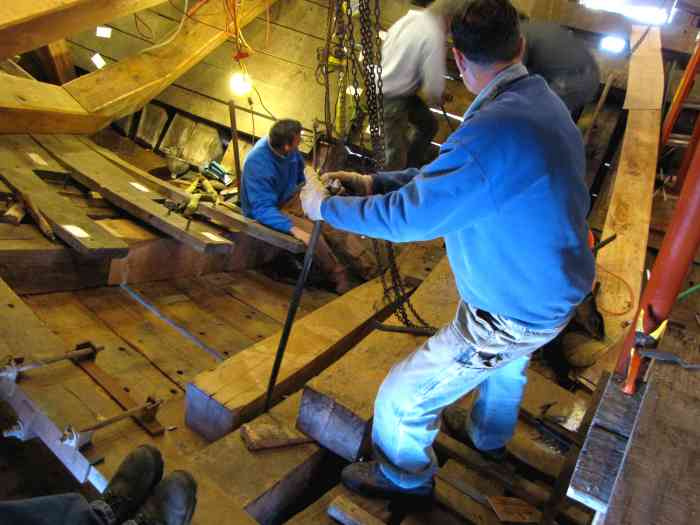
The framing on the starboard side is done!


The forward part of the keelson has been removed. The rumor is that you can smell whale oil on it.
I could not smell it but...


This is the new one.


All the framing on the port side is done. The last piece proved to be quite a "Rascal," requiring a lot of persuasion to get it in place.
But now it's done.


On the Morgan, the paint removal on the port side is done. The "Plastic Palace" came down and we are reassembling it on the starboard side. Paint is going back on where we finished scraping.


The first thing I found walking in yesterday was a new floor timber in the rough. The wood is part of the old Boston Shipyard cache.


Back in the DuPont Restoration building the mizzen mast for The Morgan is coming along.


Meanwhile up on deck, the butt joints are being cleaned out in preparation for re-caulking.


The caulking was removed while the hogging was being removed from the keel. As the keel straightened out the joints on deck moved closer together. Removing the caulking allowed for free movement of the deck planks.


The keel has a new look. At first I thought it might be a new layer of sacrificial wood used to protect the ship from worms. This was done before modern bottom paints to protect the hull. Between the sacrificial wood and the hull was a layer of Irish felt soaked in tar. The worms bore into the top layer and were stopped by the tar.
Not this time though.
This is a temporary shield used to help keep the keel's moisture level up. The Morgan has been out of the water for two years and everything is drying out. The deck is hosed down every day and spread with salt. While I have never seen it in use, I talked with a man last summer who was installing a spray system to keep the inner hull damp.
Under the protective wood is a thick layer of burlap. The burlap will be soaked daily. I assume it will be a salt water mix.


This floor timber was made from the wood found buried in Boston.


This piece weighs around 1,000 pounds.


Inside, the chain falls did the heavy work.


Lowered into place, now it's time for the fine tuning.


Here the deck clamp is being milled to size.


This is the last part of the re-framing project of Morgan's hull. On March 16, I reported that the first new futtock had been installed. On November 17, the last frame member was installed. This time it was a naval timber.


All photos and captions courtesy Carl Swebilius , Mystic Seaport and the WoodenBoat Forum


To be continued...

see editors note at the bottom of the page!


Part three of this series:

Carl continues in his volunteer work and his posts to the thread. His work following the restoration, taken on apart from his volunteer work, is a labor of love, obviously and a great resource for us, and for Mystic Seaport. The Morgan is apparently on schedule for splash in 2012 and first cruise, to New Bedford, MA in 2013.

'I'm a big fan of the WoodenBoat Forum. I almost exclusively follow the design forum, but recently thought I should take a look at the at the building forum and was rewarded by finding there a huge thread on the restoration of the Charles W Morgan, the last remaining wooden whaleboat in the world. The thread is posted by a volunteer, Carl Swebilius, who works at Mystic Seaport one day a week and follows the work being done on the Morgan as well as branching off into many other stories about Mystic. It's a casual read, but also hugely informative and entertaining. Well worth a look.

Here's what Mystic Seaport say's about the Morgan:

"The Morgan is comparable to many whaling ships of the time: 105' on deck, 133' overall. Her beam (width) is 27.7' and her draft (depth) is 12.6 feet, although fully loaded she could draw as much as 17.6', her registered depth. Her displacement (weight) is 313.75 tons.

Her longest voyage was four years and 11 months, while her shortest was 'only' eight and a half months.

The Charles W. Morgan is the last surviving wooden whaling ship from the great days of sail. Built in 1841 in New Bedford, MA, the Morgan had a successful 80-year whaling career. She made 37 voyages before retiring in 1921, and was preserved as an exhibit through the efforts of a number of dedicated citizens. After being on display in South Dartmouth, MA, until 1941, she came to Mystic Seaport, where each year thousands of visitors walk her decks and hear the fascinating story of her career as a whaling vessel, historic exhibit, film and media star, and a porthole into America's rich history."

Some numbers:

The Charles W. Morgan slid out of Jethro and Zachariah Hillman's shipyard in New Bedford, MA, on July 21, 1841.

She took 7 months to construct with 31 men working on her.

She cost $26,877 to build and another $25,977 to outfit for her first voyage.

She was 113 feet long and classed as a 351 ton whaling ship.

Her beam was 27-feet, 6-inches with a 17-foot, 6-inch depth.

Her main truck was 110 feet above the deck.

The sail capacity was over 13,000 square feet.

She carried 4 whale boats (later a fifth was added).

The Morgan typically carried a crew of 30 to 36 men.

Her cruising speeds could reach over 9 knots.

Nat Arata, VP of Development at Mystic, and my liaison for this project, along with Carl Swebilius, the volunteer who is telling the story, sent this answer to my query about what the costs from 1841 equated to in current dollars, just for some perspective. The question was answered by another VP at Mystic, Paul J. O'Pecko, Vice President, Collections and Research Director, G.W. Blunt White Library,Mystic Seaport:

"According to the website Measuringworth.com, $1340000.00 in the year 2009 has the same 'purchase power' as $52854 in the year 1841.
Another historical currency converter says 52854 dollars in 1841 had the same buying power as 1.31908712e+6 current dollars. So very close, somewhere near 1.3 million dollars."

I visited the Morgan this summer during the WoodenBoat Show this summer and have to say she is the imposing presence on the Seaport's waterfront. Out of the water as she is, the word that comes to mind is massive. Definitely worth the trip.

Editors note. I am endeavoring to keep the flavor of Carl's posts to this thread by not editing his captions. Note that I have not, by any means, used all of his work. It's all there on the thread.
This is the third post in this series, and in reviewing Carl's material, I find that I may do one more. For now, but then the work is ongoing, so I may catch up later as well.

Also, there are whaleboats to be built to kit out the Morgan properly. This work has been allocated to the Workshop on the Water at the ISM with John Brady taking the lead and Rock the Boat in NY, with Goeff McKonley, formerly of the Philadelphia Wooden Boat Factory, in charge. I met with John yesterday to discuss the project, they've already lofted to plans supplied by Mystic Seaport and will begin building the molds in a couple of weeks. The workshop will also build a set of molds to be sent to Rock the Boat. You'll be able to follow the progress of these builds here. John also hinted at the possibility that there cold be some competition in the future, and that at least one other institution, the Cold Spring Harbor Whaling Museum is considering a build. Hopefully other Museums will also partake, the New Bedford Whaling Museum would be a likely candidate.
This is a 29' whaleboat, originally built by Beetle, and has a crew of 7. There is also a gunter sailing rig. The boat is a combination of lapstrake and carvel construction. These boats should prove to be magnificent in their own right. John also raised the possibilty of a kit for the boats, to enable more institutions to build one. More to come...


Wednesday, February 9, 2011

Charles W Morgan Restoration; A Volunteer's Perspective, Part 2


Here is a work bench the shipwrights have set up.


I poked around in the stern and found the construction interesting.
It looks like three knees are laid horizontally to tie the stern together. This part of the ship was restored several years ago so it needs no further attention now.


Meanwhile on deck we are appling two coats of 1/2 turpentine and 1/2 linseed oil. The next step is a white primer.


We did a little painting last week. After two coats of a mix of raw linseed oil and turpentine the next coat was white primer. The fourth coat is a primer tinted with Grey. The final beige color looks better over a darker primer.


Below decks the framing is coming along.
You can see the progress here on both port and starboard side with the temporary work bench in the center.


My job is scraping paint and now it has evolved into painting where I helped take it off.


Meanwhile we paint and pretty soon we will begin scraping again.


The hogging is almost entirely gone now. After a year and a half of jacking the job is done.

This is the head shipwright at the Henry B. duPont Preservation Shipyard. He is removing the last of the hydraulic jacks used to raise the stem.


Yesterday I found this note


I have been coming to Mystic since about 1948. As a kid and as an adult I remember seeing the top of the prisms on the Morgans deck. In all those years of walking through the lower deck I never once looked up to see the bottom side of what I call "An Early American 100 Watter."

Here is a picture of the deck side.


I was amazed how much light actually got through. Remember, the deck is covered with shrink wrap during the restoration and that day was not particularly sunny.


I mentioned earlier about the seaport's good fortune in receiving 18 truckloads of timbers discovered in the Charleston Naval Shipyard (a/k/a Boston Naval Shipyard)
Here is what they look like.


They appear to be precut as futtocks. It's my guess that they date to the time of the civil war or earlier. Ring dating has been mentioned.
After 150 years buried in the dirt the wood still looks like it was cut down yesterday.


Things are moving along.


The crew set up the saw to cut a "Deck Clamp" from this piece of long leaf yellow pine. The piece was so long the guys had to use a hand held chainsaw to get through the length of it.
I copied the info below from this source.
http://www.navyboardmodels.com/page.php?74
On a typical ship the deck clamp is a thick horizontal plank that supports the ends of the deck beams. It also serves the very important purpose of securing all the frames, making them immovable. It runs close under each deck along the ship's side from stem to stern.
Here is the raw material.
It will be cut about 4 or 5 inches thick and I don't have a clue as to how long it is.


This is a new blubber block. Used to haul the blubber aboard, it is the largest set of blocks on board. The older blocks are to the right. They are probably not original to 1841 but were on the ship when Mystic acquired her in 1941.


The original lignum vitae sheaves will be used. They are in perfect condition.


This is the volunteer who is building them. He is also building all the other new blocks Morgan will need when she starts her 38th voyage in 2013.


All photos and captions courtesy Carl Swebilius , Mystic Seaport and the WoodenBoat Forum


To be continued...


Part two of this series:

Carl continues in his volunteer work and his posts to the thread. His work following the restoration, taken on apart from his volunteer work, is a labor of love, obviously and a great resource for us, and for Mystic Seaport. The Morgan is apparently on schedule for splash in 2012 and first cruise, to New Bedford, MA in 2013.

'I'm a big fan of the WoodenBoat Forum. I almost exclusively follow the design forum, but recently thought I should take a look at the at the building forum and was rewarded by finding there a huge thread on the restoration of the Charles W Morgan, the last remaining wooden whaleboat in the world. The thread is posted by a volunteer, Carl Swebilius, who works at Mystic Seaport one day a week and follows the work being done on the Morgan as well as branching off into many other stories about Mystic. It's a casual read, but also hugely informative and entertaining. Well worth a look.

Here's what Mystic Seaport say's about the Morgan:

"The Morgan is comparable to many whaling ships of the time: 105' on deck, 133' overall. Her beam (width) is 27.7' and her draft (depth) is 12.6 feet, although fully loaded she could draw as much as 17.6', her registered depth. Her displacement (weight) is 313.75 tons.

Her longest voyage was four years and 11 months, while her shortest was 'only' eight and a half months.

The Charles W. Morgan is the last surviving wooden whaling ship from the great days of sail. Built in 1841 in New Bedford, MA, the Morgan had a successful 80-year whaling career. She made 37 voyages before retiring in 1921, and was preserved as an exhibit through the efforts of a number of dedicated citizens. After being on display in South Dartmouth, MA, until 1941, she came to Mystic Seaport, where each year thousands of visitors walk her decks and hear the fascinating story of her career as a whaling vessel, historic exhibit, film and media star, and a porthole into America's rich history."

Some numbers:

The Charles W. Morgan slid out of Jethro and Zachariah Hillman's shipyard in New Bedford, MA, on July 21, 1841.

She took 7 months to construct with 31 men working on her.

She cost $26,877 to build and another $25,977 to outfit for her first voyage.

She was 113 feet long and classed as a 351 ton whaling ship.

Her beam was 27-feet, 6-inches with a 17-foot, 6-inch depth.

Her main truck was 110 feet above the deck.

The sail capacity was over 13,000 square feet.

She carried 4 whale boats (later a fifth was added).

The Morgan typically carried a crew of 30 to 36 men.

Her cruising speeds could reach over 9 knots.

Nat Arata, VP of Development at Mystic, and my liaison for this project, along with Carl Swebilius, the volunteer who is telling the story, sent this answer to my query about what the costs from 1841 equated to in current dollars, just for some perspective. The question was answered by another VP at Mystic, Paul J. O'Pecko, Vice President, Collections and Research Director, G.W. Blunt White Library,Mystic Seaport:

"According to the website Measuringworth.com, $1340000.00 in the year 2009 has the same 'purchase power' as $52854 in the year 1841.
Another historical currency converter says 52854 dollars in 1841 had the same buying power as 1.31908712e+6 current dollars. So very close, somewhere near 1.3 million dollars."

I visited the Morgan this summer during the WoodenBoat Show this summer and have to say she is the imposing presence on the Seaport's waterfront. Out of the water as she is, the word that comes to mind is massive. Definitely worth the trip.

Editors note. I am endeavoring to keep the flavor of Carl's posts to this thread by not editing his captions. Note that I have not, by any means, used all of his work. It's all there on the thread.
This is just the second of three posts on this voluminous thread, One more to come...'