
Clodia in Ramsgate prior to the crossing

Giacomo sailing out
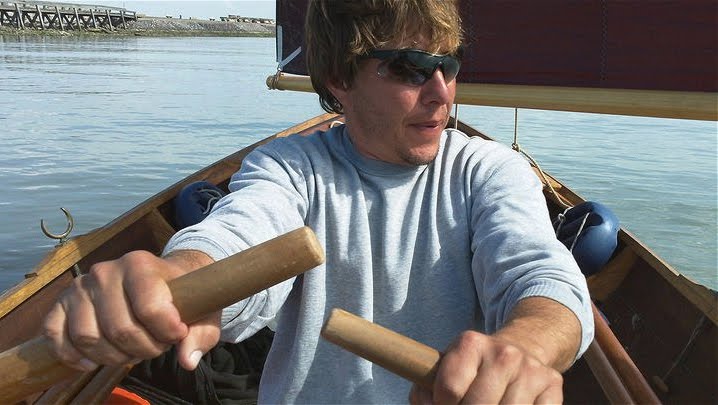
crew Bruno rowing out of Ramsgate
 Giacomo amidst the Channel
video and all photos courtesy Man on the River/Giacomo De Stefano
Our Man is back on the River, rather, this time on the sea. After a hiatus from his ambitious project, Giacomo De Stefano has triumphantly resumed his adventure after a bout with a rare and potentially deadly virus. High congratulations are in order. Giacomo and his crew Bruno Porto successfuly navigated the English channel in about 9 hours, sailing from Ramsgate Uk to Gravelines France aboard their 19' Ian Oughtred designed Ness Yawl, Clodia.
Here is Giacomo's report of the crossing:
"We did it!
Crossing the English Channel is something special:
To make it real we had to rely on many friends and on our best commitment and effort. Not to mention lots of luck.
I thought to all those people who lost their lives in these cold and troubled waters, even in the best weather conditions as we were so fortunate fo find yesterday.
Streams, sea beds,shallows, big ferries and commercial ships: A lot to worry about for a nutshell like Clodia.
We could never have done it without the help of Chalky, a sailor friend, who escorted us all the way from Ramsgate to Gravelines.
A support boat is required by maritime regulations to cross the Channel for a small boat, engine free, like our Ness Yawl.
This is the report of our day: We leave from Ramsgate at 6 o’clock after a rainy night that didn’t seem like a good omen. Chalky already offered us a good coffee.
We get out of the harbour by rowing, under a bright sun: In the meantime Paolo is filming us from the top of the pier.
To cross the shipping lanes at 90°, Chalky asks to tow us, because the wind is contrary and he wants to get to Gravelines before 4.30 p.m. for the high tide. We can’t turn his offer down, even if it doesn’t stick to our values: We could have easily made it without any help, but not following the regulamentary 90°.
We need to get out quickly from the routes of the big ships, that need many miles to stop, so we accept to get towed for what is strictly needed.
When the shipping lanes are at our back, the wind calms down. The green power of Bruno comes very handy and we row for a couple of nautical miles: Then, when we have to cope with an opposite stream of nearly 2.5 knot (faster than us!), the wind comes to our help at about 12-16 knot, keeping constant for the following hours.
We can now swiftly sail for hours: The day is beautiful and Clodia doesn’t seem to care much about the sea, running fast toward the French coast.
The last 12 miles are fantastic: We literally fly over the waves caused by streams and shallows, and by a stronger wind, reaching 6.3 knot speed.
We enter the canal of Grand Fort Philippe al 4 p.m. local time, after 9 hours and 35 nautical miles of navigation from Ramsgate. A little thrill: The gaff jumps over the peak of the mast, hit by a naughty wave. I quickly turn down the mainsail and leave the rope, avoiding any further trouble. Everything goes well, but it could have been very dangerous.
The access to the channel leading to Gravelines is a bit difficult, but we enter quite well, then we sail for the last 3 miles and dock in the wonderful Marine. Fantastic!
Gravelines welcomes us with all its peace and beauty. The fortress of Vauban is very nice.
We also discovered a 57 metres vessel, replica of the 18th century original, under construction: Impressive! Here you can find more info.
Thanks to all of you for support and help, we felt your presence every time. We dedicate a special thought to Roland, Silvio and Jacopo that should have been aboard with us.
Shortly, we’ll set sails to Saint Omer. A big hug.
Giacomo and Bruno"
You'll find map of the crossing, more on the project, and full documentation with a link to the project Flickr site at Man on the River.
See previous posts on the adventure here.
Giacomo, it's lovely to see your triumphant return, welcome back and my deepest congratulations on the successful crossing!
thomas
Here is Giacomo's report of the crossing:
"We did it!
Crossing the English Channel is something special:
To make it real we had to rely on many friends and on our best commitment and effort. Not to mention lots of luck.
I thought to all those people who lost their lives in these cold and troubled waters, even in the best weather conditions as we were so fortunate fo find yesterday.
Streams, sea beds,shallows, big ferries and commercial ships: A lot to worry about for a nutshell like Clodia.
We could never have done it without the help of Chalky, a sailor friend, who escorted us all the way from Ramsgate to Gravelines.
A support boat is required by maritime regulations to cross the Channel for a small boat, engine free, like our Ness Yawl.
This is the report of our day: We leave from Ramsgate at 6 o’clock after a rainy night that didn’t seem like a good omen. Chalky already offered us a good coffee.
We get out of the harbour by rowing, under a bright sun: In the meantime Paolo is filming us from the top of the pier.
To cross the shipping lanes at 90°, Chalky asks to tow us, because the wind is contrary and he wants to get to Gravelines before 4.30 p.m. for the high tide. We can’t turn his offer down, even if it doesn’t stick to our values: We could have easily made it without any help, but not following the regulamentary 90°.
We need to get out quickly from the routes of the big ships, that need many miles to stop, so we accept to get towed for what is strictly needed.
When the shipping lanes are at our back, the wind calms down. The green power of Bruno comes very handy and we row for a couple of nautical miles: Then, when we have to cope with an opposite stream of nearly 2.5 knot (faster than us!), the wind comes to our help at about 12-16 knot, keeping constant for the following hours.
We can now swiftly sail for hours: The day is beautiful and Clodia doesn’t seem to care much about the sea, running fast toward the French coast.
The last 12 miles are fantastic: We literally fly over the waves caused by streams and shallows, and by a stronger wind, reaching 6.3 knot speed.
We enter the canal of Grand Fort Philippe al 4 p.m. local time, after 9 hours and 35 nautical miles of navigation from Ramsgate. A little thrill: The gaff jumps over the peak of the mast, hit by a naughty wave. I quickly turn down the mainsail and leave the rope, avoiding any further trouble. Everything goes well, but it could have been very dangerous.
The access to the channel leading to Gravelines is a bit difficult, but we enter quite well, then we sail for the last 3 miles and dock in the wonderful Marine. Fantastic!
Gravelines welcomes us with all its peace and beauty. The fortress of Vauban is very nice.
We also discovered a 57 metres vessel, replica of the 18th century original, under construction: Impressive! Here you can find more info.
Thanks to all of you for support and help, we felt your presence every time. We dedicate a special thought to Roland, Silvio and Jacopo that should have been aboard with us.
Shortly, we’ll set sails to Saint Omer. A big hug.
Giacomo and Bruno"
You'll find map of the crossing, more on the project, and full documentation with a link to the project Flickr site at Man on the River.
See previous posts on the adventure here.
Giacomo, it's lovely to see your triumphant return, welcome back and my deepest congratulations on the successful crossing!
thomas


